Black women held the movement together,
acting as the “heart” or the stabilizing, “manger” force. -Nikki Giovanni
On a hot and hazy day in Washington, DC, in front of a crowd of over 250,000 people, after a program lasting over three hours, Mahalia Jackson, the second singer that day after Marian Anderson, got up and sang “I’ve Been Buked and I’ve Been Scorned,” and after the crowd shouted for an encore, “How I Got Over.” Dr. King, in a thank you note, later wrote, “Never have you sung the Lord’s song like you did that day. When I got up to speak, I was already happy.” Jackson is also credited with telling King to “tell them about the dream,” which transformed his speech into a sermon.
The inspiration for the “I Have a Dream” call-and-response can be traced to Rev. Dr. Prathia Hall Wynn. In 1962, at a prayer vigil, she led the group in a prayer and repeatedly used the phrase “I Have a Dream.” Dr. King, who attended, later asked for her permission to use the phrase in his sermon, adapting it for his historic address.
For months, leaders of major civil rights organizations prepared for the March on Washington for Jobs and Freedom. The so-called Big Six or Seven included Dr. Dorothy I. Height, known as the “Godmother of the Civil Rights Movement” and president of the National Council of Negro Women (NCNW); James Farmer, Jr., co-founder of the Congress of Racial Equality (CORE); Dr. Martin Luther King, Jr., leader of the Southern Christian Leadership Conference (SCLC); John Lewis, chair of the Student Nonviolent Coordinating Committee (SNCC); A. Philip Randolph, the elder statesman, who initiated the March and founded the Brotherhood of Sleeping Car Porters (BSCP); Roy Wilkins, the executive secretary and later executive director of the National Association for the Advancement of Colored People ( NAACP); and Whitney Young, the executive director of the National Urban League (NUL).
Bayard Rustin took the lead in organizing the march’s planning and program. Despite the work of Height and other women, a decision was made to exclude women leaders and the leaders’ wives from the front line, with Randolph, King, and other male leaders taking the lead. This exclusion reflected an attempt to diminish women’s visibility.
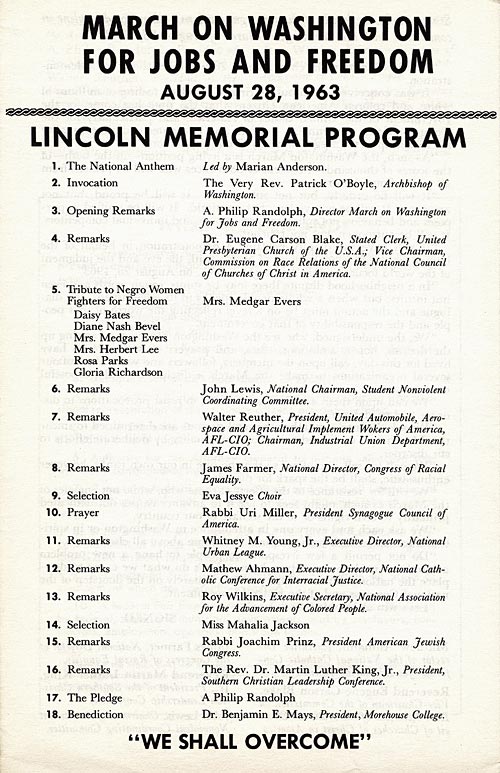
Six Black women were selected to be honored in a Tribute to Negro Women. The tribute was supposed to be delivered by Myrlie Evers, who was listed in the program as Mrs. Medgar Evers. The other five women were: Daisy Bates, president of the Arkansas NAACP and organizer of the Little Rock Nine; Diane Nash Bevel, co-founder of SNCC and strategist who helped integrate Nashville lunch counters and co-initiated the Alabama Voting Rights Project; Prince Melson Lee (Mrs. Herbert Lee), whose husband was a key NAACP organizer and was assassinated a month before the march for helping Black people register to vote; Rosa McCauley Parks, secretary of the Montgomery, Alabama, NAACP branch; and Gloria Richardson Dandridge, leader of the Cambridge movement and signatory of the July 1963 “Treaty of Cambridge.” Before the program began, the five women, who were not permitted to march at the front, led a small, separate side march along Independence Avenue to the Lincoln Memorial. Evers was unable to attend.
Daisy Bates was tasked with delivering the 142-word Tribute to Negro Women, authored by the NAACP’s John Morsell. This tribute pledged ongoing support for male leaders and included a vow to protest through sit-ins, kneel-ins, and lie-ins until voting rights were secured for every Black American. They were pledging their support to a movement where the men were centered and uplifted and their efforts and struggles were not fully acknowledged.
On this 23rd day of Black History Month, as the month draws to a close, I urge you to learn more about the women of the Civil Rights Movement. Commit to telling the entire story of how we got over. Be the person who holds up the mirror to reflect the names of those who are being forgotten. Do the hard work. Dig a little deeper. Do not let their living be in vain. Their dedication and sacrifice were central to the movement’s progress and legacy, serving as an enduring source of inspiration for those who seek justice and equality today.
Bending toward social justice,
Karsonya Wise Whitehead
|
|