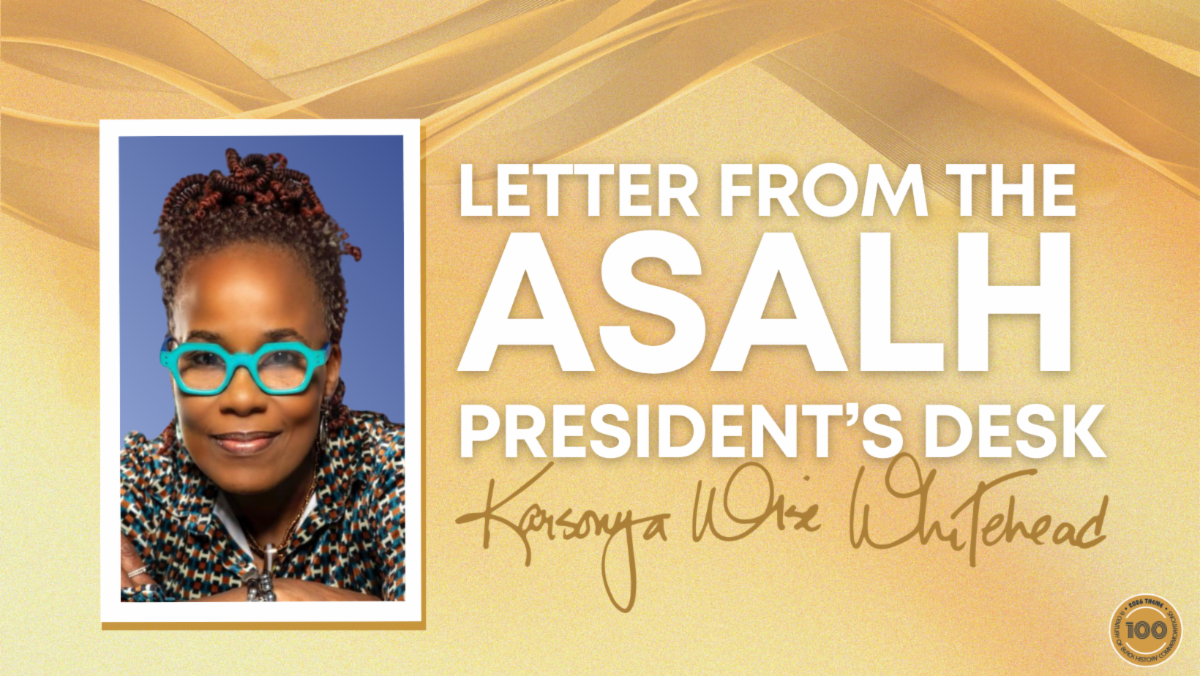
When I was younger and would get discouraged, my preacher daddy used to tell me to go out a little bit deeper and cast my net on the right side of the water. He would then say that sometimes it was not about the net getting full but about me being willing to go out a little farther. When I would run and fall down (which I did all the time), my daddy would brush off the dirt and brush away my tears and then tell me to run faster. He said that the long-term joy I got from running was much more important than the short-term pain I got from falling down. I did not understand it at the time, but these were the moments that taught me the importance of resistance and resilience. He was building my character one disappointment, one fall, and one scraped knee at a time. It is similar to what Zora Neale Hurston’s mom meant when she told Zora and them to “jump at de sun,” fully encouraging her children that even if they did not land on the sun, they at least got off the ground.
Being the president of ASALH is a lot of casting your net, going out a little but farther, getting up when you fall down, dusting off your knees and running faster, and jumping and jumping and jumping at the sun. As the 30th person and 8th woman to sit in this house, I am much closer to the sun because I stand on the shoulders of every president who has come before me. I stand firmly in the House of Woodson, but I sit proudly in the seat of Hall and Woodson – Dr. George Cleveland Hall, MD, the first president of ASNLH, who served from 1916-1917, and Dr. Mary McLeod Bethune, the first woman to serve as ASNLH’s president and who served from 1936-1951. Hall was at the table in Chicago when ASNLH was founded, and Bethune worked with Woodson to launch the Negro History Bulletin in 1937.
In addition to Hall and Bethune, the other presidents of ASALH were Robert E. Park 1917-1920, John R. Hawkins 1921-1930, John Hope 1931-1936, Bethune, Charles Harris Wesley 1952-1964, Lorenzo J. Greene 1965-1966, J. Reuben Sheeler 1966-1967, J. Rupert Picott 1968-1970, Andrew Brimmer 1971-1973, Edgar Toppin 1974-1976, Charles Walker Thomas 1977-1980, Earl E. Thorpe 1981-1982, Samuel L. Banks 1983-1984, Jeanette Cascone (acting) 1984-1985, William Harris 1986-1988, Andrew Brimmer 1989-1990, Robert Harris, Jr. 1991-1993, Janette Hoston Harris 1993-1995, Bettye J. Gardner 1995-1997, Edward Beasley 1997-1999, Samuel DuBois Cook,Sr. 1999-2001, Gloria Harper Dickinson 2001-2004, Sheila Y. Flemming 2004-2006, John Fleming 2007-2009, James Stewart 2010-2012, Daryl Michael Scott 2013-2015, Evelyn Brooks Higginbotham 2016-2021, and W. Marvin Dulaney 2022-2024.
I also have the benefit of working alongside the current Executive Director, Sylvia Cyrus, the second-longest serving ASALH ED after Woodson, who served from 1915-1950. The other ED’s include Rayford W. Logan 1950–1951, Charles Wesley 1965–1972, J. Rupert Picott 1972–1982, M. Sammye Miller 1983–1984, Bonnie J. Gillespie 1985–1987, Karen Robinson 1988–1990, Gail Hansberry 1990–1992, Karen McRae 1992–1993, Gerald R. Warren (Interim) 1994, Dixie Lee Baker (Interim) 1996, and Irena Webster 1996–2003. Their labor to keep ASALH moving forward was not in vain and has not gone unnoticed.
This is a cornerstone of the ASALH legacy – the countless hours of labor, the tears and the prayers, the missed moments and the moments of victory – that make this work both rewarding and challenging. It is a labor of love, a seed that was planted in 1915 that has been watered by every president, Executive Council member, ED, and ASALH member since then.
On this final weekend of Black History Month, as we come to the end of our Black History Month Challenges and look to meet up at our Black History Month Luncheon, I challenge you to dig your hands into the soil of ASALH and learn about the gardeners who have done the hard work to keep our garden growing for the past one hundred and eleven years.
Bending toward social justice,
Karsonya Wise Whitehead
|
|