
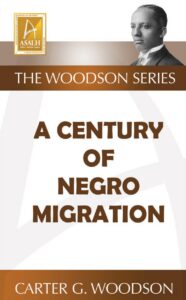
A CENTURY OF NEGRO MIGRATION
Carter G. Woodson’s A Century of Negro Migration documents the movement of African Americans from the South to the northern and western parts of the country, from the early 1800s to the early 1900s. This book gives an enlightening account of the obstacles and triumphs faced and experienced by African Americans who sought to better their lives. First Published 1918.
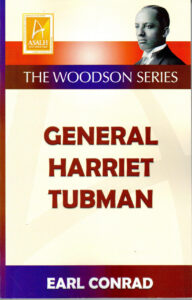
GENERAL HARRIET TUBMAN
Written by Earl Conrad and originally published by Carter G. Woodson and The Associated Publishers in 1943 and 1990, General Harriet Tubman is a well-researched and documented biography. It draws on the accounts of Tubman’s living relatives and others with expert knowledge of the period in which she lived. Perhaps, for this reason, in his Acknowledgements for the first edition, Conrad likened the book to Tubman herself: “Scores of people have contributed to the information, the understanding, and diverse other assistance that has been necessary in effecting this complete life of Harriet Tubman. I could not possibly call it my own. It is as much the property of others, and of the Negroes in particular, as Harriet herself was the claim of her people and her country.” 1943*, 1990. 248 pgs. Paperback.
*Original publication date.
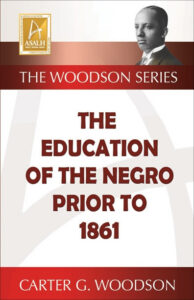
THE EDUCATION OF THE NEGRO PRIOR TO 1861
“The accounts of the successful strivings of Negroes for enlightenment under most adverse circumstances read like beautiful romances of a people in an heroic age.”
The adverse circumstances to which Woodson refers occurred during the antebellum period, from the beginning of slavery to the Civil War. In this work he chronicles the educational endeavors of Africans in America during this timeframe. He does so with the hope of “narrating in brief how benevolent teachers of both races strove to give antebellum Negroes the education through which many of them gained freedom in its highest and best sense.” 1919*. 478 pgs. Paperback.
*Original publication date
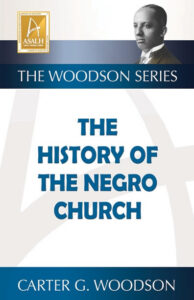
HISTORY OF THE NEGRO CHURCH
“The importance of the church in the life of the Negro justifies the publication of this brief account of the development of the institution.”
Woodson traces the influence of the Black church in America from colonial times through the early years of the twentieth century. To highlight the importance of clergy as leaders in the Black community, he includes numerous short biographies of church leaders who were instrumental in the development of various denominations or were significant members of the religious community. 1972*, 2016. 338 pgs. Paperback.
*Original publication date
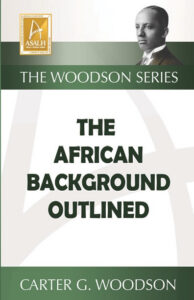
THE AFRICAN BACKGROUND OUTLINED
Woodson wrote this text to educate teachers and the general public about Africa. Part I of the book presents a brief summary of Africa’s past, including chapters on “The Negro in Africa,” “The Negro in the European Mind,” “The Negro in America,” “The Negro in Literature,” “The Negro in Art,” “The Education of the Negro,” “The Religious Development of the Negro,” and “Economic Imperialism.” Part II contains bibliographical notes and comments on these chapters and the others in the book. 1936*, 2015. 490 pgs. Paperback.
*Original publication date
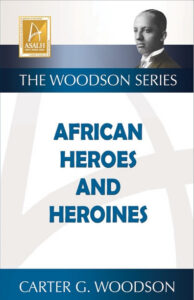
AFRICAN HEROES AND HEROINES
“To Uncle George, who in captivity in America manifested the African spirit of resistance to slavery and died fighting the institution.”
So reads Woodson’s dedication to this text, which provides a historical survey of African leaders and makes an important contribution to America’s cultural past. His text serves as a counterpoint to the largely Eurocentric narrative of African history that was popular at the time. It includes individual portraits of the Mbundu’s Queen Anna Nzinga, Shaka of the Zulu Kingdom, King Béhanzin of Dahomey and numerous others. Woodson’s objective and in-depth account of the complex political, military, and economic history of the African continent helped mainstream America move toward a more thorough understanding of its rich history. 1969*, 2016. 272 pgs. Paperback.
*Original publication date.

FREDERICK DOUGLASS
“No study of the Garrison school of reformers, Liberty party abolitionism, the technique of anti-slavery agitation or the role of the Negro in the Civil War and Reconstruction is complete without constant reference to the career of Frederick Douglass. The most prominent American Negro of the nineteenth century, he was identified with most of the reformist movements of his day.” Frederick Douglass, written by Benjamin Quarles was first published in 1948 by The Associated Publishers.
A prolific writer, Benjamin Quarles published ten books, 23 articles, and hundreds of shorter pieces. He focused his writings on meticulously exploring the contributions made by the black soldiers and abolitionists of the American Revolutionary War (1775–1783), and the American Civil War (1861–1865). He was the first Black historian to publish essays in the Mississippi Valley Historical Review, a major historical journal. 392pgs. Paperback.
ASSOCIATED PUBLISHERS PROJECT
As owners of intellectual property of the Associated Publishers, which was dissolved in 2005, the Association for the Study of African American Life and History is proud to announce a partnership with the Black Classics Press to bring the works back into print.
To order, visit www.blackclassicbooks.com or call 410.242.6954.
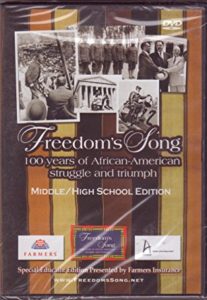 FREEDOM’S SONG DVD